Showing posts with label technology. Show all posts

TECH AND INNOVATION LEARNING


In the digital age, business leaders must stay on top of new, emerging, and future technologies or risk falling behind. But where do you start? Explore the latest digital trends to determine the best opportunities for your company.

Big Data
Big Data continues to explode in volume and variety, and companies must keep up. Learn about the latest Big Data tech trends, including real-time analytics and AI – and find out what they can do for business. 

Blockchain

Blockchain has the potential to majorly disrupt every industry. This distributed ledger technology goes far beyond cryptocurrencies to include everything from land titles and intellectual property to votes. 

Cloud Computing

From SaaS and PaaS to private and hybrid – learn more about cloud technology and its benefits. You can also investigate the latest cloud trends and hot topics, such as security and public cloud options.

Digital Business

Traditional business models are being radically disrupted in the digital economy. Discover what it takes to be a digital business – and learn about the innovative technologies driving digital transformation.

 Internet of Things

The Internet of Things (IoT) is connecting machines to machines (M2M) and machines to people in nearly every industry. Explore this world of networks – including the IIoT and Internet of Everything (IoE).

Machine Learning

Artificial intelligence (AI), machine learning, and deep learning are powering a new breed of software innovation. See how the technology can harness an ocean of Big Data to create business opportunities.

Mobile

Enterprise mobility is a key component of any digital strategy. See how you can engage your employees, customers, and stakeholders in new and innovative ways with SAP’s mobile technology and business apps.

Small and Midsize Businesses

Small and midsize businesses are inherently agile – so they can often adopt emerging technologies ahead of larger companies. See how SMEs are embracing digital disruption and new IT trends with SAP.


SAP Anywhere


   SAP Anywhere is a mobile-first, cloud-first, front-office platform aimed at very small businesses employing 10 to 500 users. It combines sales, inventory management, order processing, commerce, marketing programs, mobile point of sale (mPoS), customer support and engagement functions in one application.
According to SAP, the software enables small businesses to develop and run B2B and B2C e-commerce sites and use multi-channel marketing platforms. SAP Anywhere also has analytics and insight dashboards, allowing small businesses to discover information about customers, for example, that helps them deliver better customer experiences and services, according to the vendor. The application was initially targeted at retailers and wholesalers.

SAP Anywhere is mobile first, which means it is intended to be used and administered primarily on devices such as smartphones and tablets. This includes configurations and other administrative tasks, as well as adding custom fields or objects. The goal is to allow small businesses, which typically lack IT infrastructure and resources, to run a system that’s comparatively easy to set up, administer and use.
SAP Anywhere is an entirely new product and does not share any code with other SAP applications. Development began in 2014 at SAP Shanghai Labs, and the application was first launched in China in October 2015. It was subsequently launched in the U.K. in March 2016 and the U.S. in May 2016. SAP claimed there were more than 500 customers at the time of the U.S. launch.

It is entirely hosted and delivered in SAP’s cloud. Pricing is subscription based and three packages are available for various business requirements, such as data use and number of users.

ABAP: Does it have a Compiler or an Interpreter?

Everybody knows that ABAP is a fourth generation, high level language. But how many of us are sure as how an ABAP report is executed? Does it have a compiler or an Interpreter or both (hmm)?? Well, the answer is:
“To some extent it has both”. To elaborate it: Before an ABAP program is executed, the ABAP compiler must translate it into an intermediate language. This form of program i.e. the program in this intermediate form is called an ABAP load.

You might know that an ABAP program has a modular structure.
These modules are called as processing blocks. It is just rephrasing stunt. Logically, if we see any ABAP program, it contains two parts:
1. The first part has the global declarations.
2. And the second part contains the processing blocks. 

are several types of processing blocks which includes dialog modules and subprograms. More precisely, there are the following types of processing blocks:
1. Dialog modules
2. Event blocks
3. Subprograms (subroutines, function modules and methods).  

The dialog modules are called from the screen flow logic. The subprograms are called using ABAP statements which themselves are part of some other processing block and event blocks are called from outside an ABAP program.  Now the ABAP load contains processing blocks in one-to-one correspondence to the processing blocks of the ABAP program, that is, for each processing block in the ABAP program, there is exactly one processing block in the corresponding ABAP load.” 
Before executing any processing block, it is first be determined whether the corresponding ABAP program has already been compiled or not. If it had been already compiled, the ABAP Virtual Machine can immediately begin executing the processing block; else the ABAP compiler must first translate the ABAP program into an ABAP load and then execute it.


SAP BASIS INTRODUCTION.

Basis is the operating system for SAP applications and ABAP. Basis provides services like communication with the operating system, database communication, memory management, runtime collection of application data, web requests, exchanging business data etc...
Basis is a set of programs and tools that act as an interface with Database, Operating system, Communication protocols and business applications (such as FI, CO, MM, etc).
 Full form of BASIS is "Business Application Software Integrated solution"
SAP applications such as FI, CO, PP etc. can run and communicate with each other across different Operating systems and Databases with the help of BASIS.

Nowadays Basis is known as NetWeaver.

Alias of BASIS is SAP Application Server Technology and alias of NetWeaver is SAP Web Application Server.

Basis supports a number of known operating systems (Unix flavors, Microsoft windows server edition, AS400,z/OS,etc) and databases (Oracle,DB2,Informix,Maxdb,Microsoft SQL Server,etc)..


Basis is the SAP version of system administration. In most non-SAP organizations, "Basis" people will be called "system administrators." Basis administrators are responsible for ensuring that the SAP application server and applications are installed and configured properly and remain running smoothly. Depending on the organization, SAP Basis administrators may also be responsible for configuring and maintaining the operating system and database that SAP is running on, but in many organizations there are other system administrators responsible for operating systems and databases that work with Basis experts to configure the full system.


INTRODUCTION TO MODULES IN SAP

What are modules in SAP?
SAP solutions include a number of functional modules, which support transactions to execute key business processes, such as − Financial Accounting (FI) Financial Supply, Chain Management (FSCM), Controlling (CO), Materials Management (MM).
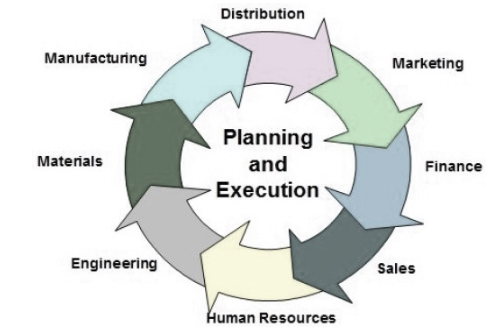
Each ERP module is focused on one area of business processes, such as product development or marketing. Some of the more common ERP modules include those for product planning, material purchasing, inventory control, distribution, accounting, marketing, finance and HR.


There are 2 Types of SAP ERP Modules. Number one is Functional Modules and second one is Technical Modules. All SAP Modules integrated with each other with functionality and provide us best solution for Business. Most important SAP Modules that Bunnies implement for their business are
SAP FICO module
MM Module
SD module
HR module
PP module
PS module
Basis module
Security module
ABAP module

SAP is a truly global enterprise which serves 350,000 customers in 180 countries. According to SAP.com, around 76% of the world’s transaction revenue touches an SAP system. Not only is SAP already a mammoth organization, it is also growing at a rapid rate achieving significant and sustainable growth, with the number of licensed customers implementing systems such as SAP S/4HANA growing year on year. This has led to a huge demand for a broad range of SAP professionals from functional and technical consultants to architects and developers.
There are total of 25 modules in total and deciding which ones will be best for honing your skills is an important decision for those looking to build an SAP career. Networkers reveal the top 5 highest paying SAP modules and the associated pay rates below.

1. SAP S/4HANA (High-Performance Analytic Appliance)
2. SAP ECC FI (Financial Accounting)
3. SAP SCM (Supply Chain Management)
4. SAP HCM (Human Capital Management)
5. SAP BI (Business Intelligence)


INTRODUCTION TO SAP R/3 ARCHITECTURE AND HANA.

What is sap r/3 architecture?
SAP R/3 is a 3 tier architecture consisting of 3 layers
Presentation
Application
Database

In simple words, it’s a client server architecture.

R signifies Real-time system
3 represents - 3-tier architecture.

User's PC:-  Users can access SAP system in two ways:-
Through SAP GUI
Through Web browser

It's called front-end. Only the front-end is installed in the user's PC not the application/database servers .Front-end takes the user's requests to database server and application servers.


Application Servers: -
 Application server is built to process business-logic. This workload is distributed among multiple application servers. With multiple application servers, the user can get the output more quickly .Application server exists at a remote a location as compared to the location of the user PC.

Database Servers: -
Database server stores and retrieves data as per SQL queries generated by ABAP and Java applications .Database and Application may exist on the same or different physical location.


LAYERS:-

Presentation Layer:
The Presentation Layer contains the software components that make up the SAPgui (graphical user interface). This layer is the interface between the R/3 System and its users.

Application Layer:
The Application Layer consists of one or more application servers and a message server. Each application server contains a set of services used to run the R/3 System. Theoretically, you only need one application server to run an R/3 System.
In practice, the services are distributed across more than one application server. The message server is responsible for communication between the application servers. It passes requests from one application server to another within the system.

Database Layer:
The Database Layer consists of a central database system containing all of the data in the R/3 System. The database system has two components - the database management system (DBMS), and the database itself. SAP has manufactured its own database named Hana but is compatible with all major databases such as Oracle.
All R/3 data is stored in the database. For example, the database contains the control and customizing data that determine how your R/3 System runs. It also contains the program code for your applications. Applications consist of program code, screen definitions, menus, function modules, and various other components. These are stored in a special section of the database called the R/3 Repository, and are accordingly called repository objects. R/3 repository, objects are used in ABAP workbench.

SAP HANA AND S/4 HANA.
SAP R3 is the application structure, represents SAPs 3 tier architecture (App , Pres , and DB layers). Each SAP application is a 3 tier where DB is traditional databases like Oracle , DB2 , SQL , MSSQL , Sybase etc… from the last couple of years there is new database is added to this list called “HANA”.

HANA is SAP’s own database and developed for more accuracy and faster in terms of performance more time better than any other database existed due to because of its in-memory concept.
Now HANA is rapidly developing for many upcoming technologies like first and foremost its UI called Fiori and for cloud apps, IOT, Predictive analytics, SDA so many new features were implemented in recent developments of HANA releases….


INTRODUCTION TO SAP ERP SOFTWARE


INTRODUCTION TO SAP ERP SOFTWARE

What is ERP?
Enterprise Resource Planning (ERP) is a software that is built to organizations belonging to different industrial sectors, regardless of their size and strength.
The ERP package is designed to support and integrate almost every functional area of a business process such as procurement of goods and services, sale and distribution, finance, accounting, human resource, manufacturing, production planning, logistics & warehouse management.


What is SAP?
SAP stands for Systems Applications and Products in Data Processing.
SAP by definition is also named of the ERP (Enterprise Resource Planning) software as well the name of the company.


SAP Software was Founded in 1972 by Wellenreuther, Hopp, Hector, Plattner and Tschira.
SAP software products provide powerful instruments for helping companies to manage their financials, logistics, human resources, and other business areas. The backbone of SAP software offering is SAP ERP system which is the most advanced Enterprise Resource Planning (ERP) system from currently available ones.
Their basic premise was to create a software program to process data whenever a user wants access.
SAP stands for “Systeme, Anwendungen, Produke”, which translates to “Systems, Applications, and Products”.
SAP is a software program that can manage a corporation or business as a whole, across different departments.


5 Linux Distros That Are Perfect For People Who Don’t Like Linux   


What is Distro actually?
Distro is IT vernacular for a Linux operating system (OS). It is a shortened version of the term distribution. In the Linux world, there are hundreds of different flavors of distro.
Examples include Debian, Ubuntu and Red Hat (among many others).
When referencing a Linux OS, administrators usually ask questions like: Which distro does the application sit on top of? or Which distro are you using?
Technically, a distribution is any deployment of software and isn't specifically Linux. Usually in this case you'll hear it referred to as a "distribution of software.
"Despite this, the term "distro" is nearly always used in a Linux context.
So, while a distribution of software is a generic term for any bundle of software, distro is nearly always a flavor of Linux.

For example,
When deciding to use Linux – on a desktop computer or server – you’ll first need to choose a distro.
For many people, Ubuntu has become synonymous with Linux.
But Ubuntu is one of many distros, and you have a lot of choice when it comes to Linux.

 What is Linux Distro?
Linux isn’t like Windows or Mac OS X. Microsoft combines all the bits of Windows internally to produce each new release of Windows and distributes it as a single package. If you want Windows, you’ll need to choose one of the versions Microsoft is offering.
Linux works differently.
The Linux operating system isn’t produced by a single organization. Different organizations and people work on different parts. There’s the Linux kernel (the core of the operating system), the GNU shell utilities (the terminal interface and many of the commands you use), the X server (which produces a graphical desktop), the desktop environment (which runs on the X server to provide a graphical desktop), and more.
System services, graphical programs, terminal commands – many are developed independently from another. They’re all open-source software distributed in source code form.
With all that in mind, let's take a brief look at the DistroWatch top five over the last few months.

From the bottom up we find:

5: Debian :  I've never been a big Debian fan -- I much prefer Debian-based distributions such as Ubuntu and Mepis --but lots of other people are. Debian, which just turned 19, remains important not just because it is the foundation for many other Linux distributions, but because year after year it continues to be loved by its users.

4: Fedora : But while Debian isn't one of my favorites, I confess I really haven't cared for Fedora, Red Hat's community Linux distribution, in recent years. Well, it's not so much Fedora, it's the fact that it uses GNOME 3.x -- the desktop interface I love to hate.
Regardless of how I feel about it though, Fedora clearly has its fans.
And, if you work on Red Hat Enterprise Linux (RHEL) development, it's a really wise idea to keep a copy of Fedora on hand so you can see RHEL's future.

 3: Ubuntu :  What's that you say? Ubuntu: the darling of so many Linux fans only in third place? Yep. It's in third.
Why? Well even though I like its relatively new Unity interface, a lot of other people really don't. I think that mostly it's because while Unity is great for new users who aren't especially computer savvy, a lot of Linux professionals find it gets in the way -- and, of course, experienced old Linux hands are exactly the kind of people who visit DistroWatch.
That said, Ubuntu founder Mark Shuttleworth thinks the operating system will see 20 million new PCs sold with Ubuntu in 2012, and that's not counting people who install it. Those people will also largely be new computer users.
If Ubuntu can get most of the new users coming to Linux, I think they'll be happy even if they're no longer as popular with old-guard Linux desktop users.

2: Mageia :  And, number two is, "who?" I can hear some of you asking.
Mageia is a September 2010 fork of Mandriva Linux, a commercial Linux distribution, which was once quite popular in its own right. In 2006, Mandriva suffered management and financial problems. Since then, while the firm has continued to have problems, Mageia -- freed of Mandrivia's business woes -- has continued on to become a wildly popular Linux distribution.
And why is Mageia so popular? I think it's because it's a straightforward easy-to-use Linux distribution. Unlike Ubuntu's Unity user interface, Mageia uses the Linux pro friendly KDE 4.8 desktop. In short, it's just a darn good KDE distribution -- which, by the way -- according to LinuxQuestions' last survey, is now the single most popular desktop interface of all.

1: Mint Linux : This should come as no surprise. Mint is an excellent distribution and my own personal favorite. Users have enjoyed and loved using it ever since Ubuntu started down the Unity path. What Mint has going for it is an outstanding desktop interface of its own, Cinnamon, which is very remindful of the classic GNOME 2.x interface. Add to that outstanding software and hardware support, there's little question as to why Mint still appears to be the most desktop popular Linux of all.

Thank you!

With which programming language I should start?

WITH WHICH PROGRAMMING LANGUAGE I SHOULD START?

Well, this question is very frequent in all the students who has just put their step into programming world and looking forward themselves as programmer or developer!!!
Nowadays, students after completing their 10th, they are eager to learn more and more about this smart machine and want to instruct this smart machine!
But the question is which language they should use for instructing computers, which is easy to code for them as well?
Let me give an example of humans. If a person comes to me to learn human languages, obviously, I will not start his coaching with 'Japanese'. That’s one language I probably wouldn’t want to start him off with, simply because it’s a little complicated. A little bit more complicated than say Spanish or English, which are on the language difficulty spectrum, they’re on level one. At the same time if you think about this, human language, like English and Spanish, you can’t say that just because they’re simpler it means that they aren’t very powerful. They’re spoken worldwide and a lot of people understand them. Even though they’re simple, they’re still pretty powerful. Now let’s transition that over to computer programming, “What language should I start off with?” Well, to answer that question I would say, start off with the simplest language. Definitely do not get started off with a really complicated language.

Syntaxes of languages
Syntax refers to the spelling and grammar of a programming language. Computers are inflexible machines that understand what you type only if you type it in the exact form that the computer expects. The expected form is called the syntax.
Computer programming languages, you’re trying to express ideas to a computer so it can translate it for you. It’s a really smart friend that is right there, who’s listening to you, you just need to speak to him. Okay, now I want to talk about what languages maybe you should not start off with.
So, starting with the actual answer to your question, let me clear the definition of programming.

What is computer programming?
It is the process of developing and implementing various sets of instructions to enable a computer to do a certain task. These instructions are considered computer programs and help the computer to operate smoothly. The language used to program computers is not understood by an untrained eye. Computer programming continues to be a necessary process as the Internet continues to expand.

Which programming language is easy?
Most programmers would agree that high-level scripting languages are relatively easy to learn. JavaScript falls into this category, along with Python and Ruby. Even though universities still teach languages like Java and C++ as first languages, they're considerably harder to learn.


Start with Python!!!

COMPARISON BETWEEN C AND PYTHON

You will think why not c? , so the reasons are listed below:
1) Python is a very popular interpreted scripting language. C is a very popular compiled language. Due to its compiled nature, C is generally faster than Python, but is lower-level, making Python programming quicker and easier than C programming.
2) C is syntactically hard. As the previous example of human languages, learning should be started with English language, rather than Japanese as it is syntactically hard. Similarly with C and Python.
COMPARISION BETWEEN JAVA AND PYTHON

1) While Python can be more user-friendly than Java, as it has a more intuitive coding style, both languages do have their unique advantages for developers and end users. However, if you are just beginning your path towards a programming career, you might want to start by learning Python, as it is less complex.
2) Python (the language) has many run-time implementations. CPython is usually interpreted, and will be slower than native-code C#. It might be slower than Java, depending on the Java JIT compiler. JYthon is interpreted in the JVM and has the same performance profile as Java.

Here are some oft-used languages at various companies as reported in cracking the Coding Interview and on Quora:
Facebook: PHP, C++, Python, Java, Perl. ...
Google: officially C/C++, Java, Python, JavaScript, Go
Amazon: Java, JavaScript, Ruby, Python, Perl
Microsoft: C++, C#, Java, Python

I do agree that Python is a brilliant language to teach programming because of its easy syntax and I often recommend Python to programming newcomers. Python or even VB.NET is probably one of the better languages learn.

Thank You!


China's Plan For AI


Major portion of China's GDP (Gross Domestic Product) comes from the manufacturing sector and that is why China is one of those countries which are going to benefit most due to AI. Challenging U.S dominance in the AI sector, Beijing has presented its plan to become the world-leader in AI by 2025. It released a national artificial intelligence (AI) development plan. China expects its core AI industries to exceed a value of $22.15 billion in 2020 and $59.07 billion in 2025. China's State Council said in a notice that it will encourage cross-border cooperation as part of the strategy. US is concerned over the increased amounts of investment of China in its AI sector fearing China could access technology of strategic military importance. Moreover China is following a similar national AI development plan released by the US in October last year. China is aiming to catch up with the global leaders by getting rid of issues like lack of high-end computer chips and equipment, software and trained personnel. It plans to strengthen links between private firms, research bodies and military bodies to promote mutual development in AI. Top Chinese firms like Baidu Inc. (also known as China's Google) and Tencent Holdings Ltd. have established research bases in the US. China has begun investing heavily in artificial intelligence technology.

At the opening ceremony of the 17th Congress of the Chinese Academy of Sciences in 2014, President Xi Jinping called for innovation and breakthroughs in science and technology, including AI. Following 2014, there have been a series of national economic initiatives which includes the 13th Five Year Plan (March 2015), Made in China 2025 (May 2016), Robotics Industry Development Plan (April 2016), and Three-year Guidance for Internet Plus Artificial Intelligence Plan (May 2016), which provided guidelines to boost AI R&D. China’s top economic planner, the National Development and Research Commission (NDRC), announced that it would create an AI market worth more than US$15.26 billion by 2018. In 2016, a report by White house indicated that the number of academic research papers published in China in the field of deep learning exceeded the number published by U.S. researchers. Another study reported that Chinese patent applications in the segment of AI grew to 8,410 between 2010 and 2014, a 186 percent increase from the previous five-year period. Scientists refer AI as the core of the next wave of industrialization and China realizes that. 


According to a report, this technology will contribute as much as $15.7 trillion to output by 2030, that's more than the current combined output of China and India. China is looking to compete with US market leaders such as Alphabet Inc's Google and Microsoft Corp. Another report estimated that AI could increase China’s annual growth rate by 1.6 percentage point to 7.9 percent by 2035 in terms of gross value added. 

US hightened its scrutiny over China's investment in Silicon Valley as it fears that is vital for its National security.   It is worried that China could use this cutting edge technology to increase its military capabilities and further push strategic industries. A Pentagon report warns that China is gaining access to sensitive technology. China is viewing this as the fourth industrial revolution and trying to build a very strong ecosystem around it.

Amid warnings of the economic disruption that robots and automation could unleash on the world economy as traditional roles disappear, researchers are finding that new technologies will help fuel global growth as productivity and consumption soar. AI will contribute as much as $15.7 trillion to the world economy by 2030. Global GDP, which stood at about $74 trillion in 2015, will be 14 percent higher in 2030 as a result of AI. Albeit the benefits against risks and costs of the AI technology are discussed, China has made it clear that it is getting ready to bring and be a part of the transformational changes that AI promises. 


Intuition and Business

Everyone makes many mistakes in business. But one does not have to beat himself up about them, in fact he has to be greatful to have made th...