Showing posts with label SAP SOFTWARE. Show all posts

SAP Anywhere


   SAP Anywhere is a mobile-first, cloud-first, front-office platform aimed at very small businesses employing 10 to 500 users. It combines sales, inventory management, order processing, commerce, marketing programs, mobile point of sale (mPoS), customer support and engagement functions in one application.
According to SAP, the software enables small businesses to develop and run B2B and B2C e-commerce sites and use multi-channel marketing platforms. SAP Anywhere also has analytics and insight dashboards, allowing small businesses to discover information about customers, for example, that helps them deliver better customer experiences and services, according to the vendor. The application was initially targeted at retailers and wholesalers.

SAP Anywhere is mobile first, which means it is intended to be used and administered primarily on devices such as smartphones and tablets. This includes configurations and other administrative tasks, as well as adding custom fields or objects. The goal is to allow small businesses, which typically lack IT infrastructure and resources, to run a system that’s comparatively easy to set up, administer and use.
SAP Anywhere is an entirely new product and does not share any code with other SAP applications. Development began in 2014 at SAP Shanghai Labs, and the application was first launched in China in October 2015. It was subsequently launched in the U.K. in March 2016 and the U.S. in May 2016. SAP claimed there were more than 500 customers at the time of the U.S. launch.

It is entirely hosted and delivered in SAP’s cloud. Pricing is subscription based and three packages are available for various business requirements, such as data use and number of users.

ABAP: Does it have a Compiler or an Interpreter?

Everybody knows that ABAP is a fourth generation, high level language. But how many of us are sure as how an ABAP report is executed? Does it have a compiler or an Interpreter or both (hmm)?? Well, the answer is:
“To some extent it has both”. To elaborate it: Before an ABAP program is executed, the ABAP compiler must translate it into an intermediate language. This form of program i.e. the program in this intermediate form is called an ABAP load.

You might know that an ABAP program has a modular structure.
These modules are called as processing blocks. It is just rephrasing stunt. Logically, if we see any ABAP program, it contains two parts:
1. The first part has the global declarations.
2. And the second part contains the processing blocks. 

are several types of processing blocks which includes dialog modules and subprograms. More precisely, there are the following types of processing blocks:
1. Dialog modules
2. Event blocks
3. Subprograms (subroutines, function modules and methods).  

The dialog modules are called from the screen flow logic. The subprograms are called using ABAP statements which themselves are part of some other processing block and event blocks are called from outside an ABAP program.  Now the ABAP load contains processing blocks in one-to-one correspondence to the processing blocks of the ABAP program, that is, for each processing block in the ABAP program, there is exactly one processing block in the corresponding ABAP load.” 
Before executing any processing block, it is first be determined whether the corresponding ABAP program has already been compiled or not. If it had been already compiled, the ABAP Virtual Machine can immediately begin executing the processing block; else the ABAP compiler must first translate the ABAP program into an ABAP load and then execute it.


SAP BASIS INTRODUCTION.

Basis is the operating system for SAP applications and ABAP. Basis provides services like communication with the operating system, database communication, memory management, runtime collection of application data, web requests, exchanging business data etc...
Basis is a set of programs and tools that act as an interface with Database, Operating system, Communication protocols and business applications (such as FI, CO, MM, etc).
 Full form of BASIS is "Business Application Software Integrated solution"
SAP applications such as FI, CO, PP etc. can run and communicate with each other across different Operating systems and Databases with the help of BASIS.

Nowadays Basis is known as NetWeaver.

Alias of BASIS is SAP Application Server Technology and alias of NetWeaver is SAP Web Application Server.

Basis supports a number of known operating systems (Unix flavors, Microsoft windows server edition, AS400,z/OS,etc) and databases (Oracle,DB2,Informix,Maxdb,Microsoft SQL Server,etc)..


Basis is the SAP version of system administration. In most non-SAP organizations, "Basis" people will be called "system administrators." Basis administrators are responsible for ensuring that the SAP application server and applications are installed and configured properly and remain running smoothly. Depending on the organization, SAP Basis administrators may also be responsible for configuring and maintaining the operating system and database that SAP is running on, but in many organizations there are other system administrators responsible for operating systems and databases that work with Basis experts to configure the full system.


INTRODUCTION TO MODULES IN SAP

What are modules in SAP?
SAP solutions include a number of functional modules, which support transactions to execute key business processes, such as − Financial Accounting (FI) Financial Supply, Chain Management (FSCM), Controlling (CO), Materials Management (MM).
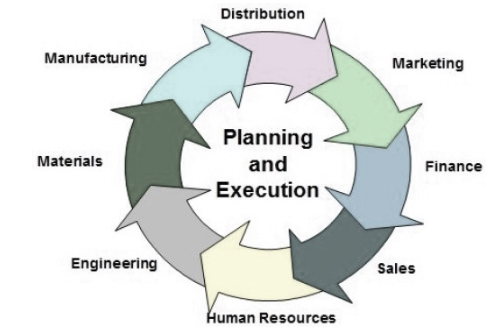
Each ERP module is focused on one area of business processes, such as product development or marketing. Some of the more common ERP modules include those for product planning, material purchasing, inventory control, distribution, accounting, marketing, finance and HR.


There are 2 Types of SAP ERP Modules. Number one is Functional Modules and second one is Technical Modules. All SAP Modules integrated with each other with functionality and provide us best solution for Business. Most important SAP Modules that Bunnies implement for their business are
SAP FICO module
MM Module
SD module
HR module
PP module
PS module
Basis module
Security module
ABAP module

SAP is a truly global enterprise which serves 350,000 customers in 180 countries. According to SAP.com, around 76% of the world’s transaction revenue touches an SAP system. Not only is SAP already a mammoth organization, it is also growing at a rapid rate achieving significant and sustainable growth, with the number of licensed customers implementing systems such as SAP S/4HANA growing year on year. This has led to a huge demand for a broad range of SAP professionals from functional and technical consultants to architects and developers.
There are total of 25 modules in total and deciding which ones will be best for honing your skills is an important decision for those looking to build an SAP career. Networkers reveal the top 5 highest paying SAP modules and the associated pay rates below.

1. SAP S/4HANA (High-Performance Analytic Appliance)
2. SAP ECC FI (Financial Accounting)
3. SAP SCM (Supply Chain Management)
4. SAP HCM (Human Capital Management)
5. SAP BI (Business Intelligence)


INTRODUCTION TO SAP R/3 ARCHITECTURE AND HANA.

What is sap r/3 architecture?
SAP R/3 is a 3 tier architecture consisting of 3 layers
Presentation
Application
Database

In simple words, it’s a client server architecture.

R signifies Real-time system
3 represents - 3-tier architecture.

User's PC:-  Users can access SAP system in two ways:-
Through SAP GUI
Through Web browser

It's called front-end. Only the front-end is installed in the user's PC not the application/database servers .Front-end takes the user's requests to database server and application servers.


Application Servers: -
 Application server is built to process business-logic. This workload is distributed among multiple application servers. With multiple application servers, the user can get the output more quickly .Application server exists at a remote a location as compared to the location of the user PC.

Database Servers: -
Database server stores and retrieves data as per SQL queries generated by ABAP and Java applications .Database and Application may exist on the same or different physical location.


LAYERS:-

Presentation Layer:
The Presentation Layer contains the software components that make up the SAPgui (graphical user interface). This layer is the interface between the R/3 System and its users.

Application Layer:
The Application Layer consists of one or more application servers and a message server. Each application server contains a set of services used to run the R/3 System. Theoretically, you only need one application server to run an R/3 System.
In practice, the services are distributed across more than one application server. The message server is responsible for communication between the application servers. It passes requests from one application server to another within the system.

Database Layer:
The Database Layer consists of a central database system containing all of the data in the R/3 System. The database system has two components - the database management system (DBMS), and the database itself. SAP has manufactured its own database named Hana but is compatible with all major databases such as Oracle.
All R/3 data is stored in the database. For example, the database contains the control and customizing data that determine how your R/3 System runs. It also contains the program code for your applications. Applications consist of program code, screen definitions, menus, function modules, and various other components. These are stored in a special section of the database called the R/3 Repository, and are accordingly called repository objects. R/3 repository, objects are used in ABAP workbench.

SAP HANA AND S/4 HANA.
SAP R3 is the application structure, represents SAPs 3 tier architecture (App , Pres , and DB layers). Each SAP application is a 3 tier where DB is traditional databases like Oracle , DB2 , SQL , MSSQL , Sybase etc… from the last couple of years there is new database is added to this list called “HANA”.

HANA is SAP’s own database and developed for more accuracy and faster in terms of performance more time better than any other database existed due to because of its in-memory concept.
Now HANA is rapidly developing for many upcoming technologies like first and foremost its UI called Fiori and for cloud apps, IOT, Predictive analytics, SDA so many new features were implemented in recent developments of HANA releases….


INTRODUCTION TO SAP ERP SOFTWARE


INTRODUCTION TO SAP ERP SOFTWARE

What is ERP?
Enterprise Resource Planning (ERP) is a software that is built to organizations belonging to different industrial sectors, regardless of their size and strength.
The ERP package is designed to support and integrate almost every functional area of a business process such as procurement of goods and services, sale and distribution, finance, accounting, human resource, manufacturing, production planning, logistics & warehouse management.


What is SAP?
SAP stands for Systems Applications and Products in Data Processing.
SAP by definition is also named of the ERP (Enterprise Resource Planning) software as well the name of the company.


SAP Software was Founded in 1972 by Wellenreuther, Hopp, Hector, Plattner and Tschira.
SAP software products provide powerful instruments for helping companies to manage their financials, logistics, human resources, and other business areas. The backbone of SAP software offering is SAP ERP system which is the most advanced Enterprise Resource Planning (ERP) system from currently available ones.
Their basic premise was to create a software program to process data whenever a user wants access.
SAP stands for “Systeme, Anwendungen, Produke”, which translates to “Systems, Applications, and Products”.
SAP is a software program that can manage a corporation or business as a whole, across different departments.


Intuition and Business

Everyone makes many mistakes in business. But one does not have to beat himself up about them, in fact he has to be greatful to have made th...