Showing posts with label modernisation. Show all posts

Big Data Analytics

Big data analytics examines large amounts of data to uncover hidden patterns, correlations and other insights. With today’s technology, it’s possible to analyze your data and get answers from it almost immediately – an effort that’s slower and less efficient with more traditional business intelligence solutions.

So, What exactly is Big Data?


Big data is a term for data sets that are so large or complex that traditional data processing application software is inadequate to deal with them. Big data challenges include capturing data, data storage, data analysis, search, sharing, transfer, visualization, querying, updating and information privacy.

Why is Big Data Analytics Important?


Big data analytics helps organizations harness their data and use it to identify new opportunities. That, in turn, leads to smarter business moves, more efficient operations, higher profits and happier customers. In his report Big Data in Big Companies, IIA Director of Research Tom Davenport interviewed more than 50 businesses to understand how they used big data. He found they got value in the following ways:


Cost reduction
Big data technologies such as cloud-based analytics bring significant cost advantages when it comes to storing large amounts of data – plus they can identify more efficient ways of doing business.


Faster, better decision making
With the speed of in-memory analytics, combined with the ability to analyze new sources of data, businesses are able to analyze information immediately – and make decisions based on what they’ve learned.


New products and services
With the ability to gauge customer needs and satisfaction through analytics comes the power to give customers what they want. Davenport points out that with big data analytics, more companies are creating new products to meet customers’ needs.

What Challenges does it face?


Potential pitfalls that can trip up organizations on big data analytics initiatives include a lack of internal analytics skills and the high cost of hiring experienced data scientists and data engineers to fill the gaps.


The amount of data that's typically involved, and its variety, can cause data management issues in areas including data quality, consistency and governance; also, data silos can result from the use of different platforms and data stores in a big data architecture. In addition, integrating Hadoop, Spark and other big data tools into a cohesive architecture that meets an organization's big data analytics needs is a challenging proposition for many IT and analytics teams, which have to identify the right mix of technologies and then put the pieces together.

LiFi: The Future Of Internet


Li-Fi technology is a ground-breaking light-based communication technology, which makes use of light waves instead of radio technology to deliver data achieving speeds of 224 gigabits per second in the labs. This technology has potential to change everything about the way we use the Internet.

So let's get to know more about this seemingly impossible technological marvel.


First of all, What is this LiFi?


Light Fidelity or Li-Fi is a Visible Light Communications (VLC) system running wireless communications travelling at very high speeds.Li-Fi uses common household LED (light emitting diodes) light bulbs to enable data transfer, boasting speeds of up to 224 gigabits per second.

The term Li-Fi was coined by University of Edinburgh Professor Harald Haas during a TED Talk in 2011. Haas envisioned light bulbs that could act as wireless routers.Subsequently, in 2012 after four years of research, Haas set up company pureLiFi with the aim 'to be the world leader in Visible Light Communications technology'.

So, How does it works?


Li-Fi and Wi-Fi are quite similar as both transmit data electromagnetically. However, Wi-Fi uses radio waves while Li-Fi runs on visible light.As we now know, Li-Fi is a Visible Light Communications (VLC) system. This means that it accommodates a photo-detector to receive light signals and a signal processing element to convert the data into 'stream-able' content.


An LED light bulb is a semi-conductor light source meaning that the constant current of electricity supplied to an LED light bulb can be dipped and dimmed, up and down at extremely high speeds, without being visible to the human eye.For example, data is fed into an LED light bulb (with signal processing technology), it then sends data (embedded in its beam) at rapid speeds to the photo-detector (photodiode).

The tiny changes in the rapid dimming of LED bulbs is then converted by the 'receiver' into electrical signal.The signal is then converted back into a binary data stream that we would recognise as web, video and audio applications that run on internet enables devices.

Will it make WiFi obsolete?


While some may think that Li-Fi with its 224 gigabits per second leaves Wi-Fi in the dust, Li-Fi's exclusive use of visible light could halt a mass uptake. Li-Fi signals cannot pass through walls, so in order to enjoy full connectivity, capable LED bulbs will need to be placed throughout the home.
 Not to mention, Li-Fi requires the light bulb is on at all times to provide connectivity, meaning that the lights will need to be on during the day.Additionally, where there is a lack of light bulbs, there is a lack of Li-Fi internet so Li-Fi does take a hit when it comes to public Wi-Fi networks.

In an announcement yesterday, an extension of standard Wi-Fi is coming and it's called Wi-Fi HaLow.This new project claims to double the range of connectivity while using less power. Due to this, Wi-Fi HaLow is reportedly perfect for battery powered devices such as smartwatches, smartphones and lends itself to Internet of Things devices such as sensors and smart applications. 

But it's not all doom and gloom! Due to its impressive speeds, Li-Fi could make a huge impact on the internet of things too, with data transferred at much higher levels with even more devices able to connect to one another.

Expect to hear a lot more about this revolutionary technology in coming months. There's hardly any time left before this technology becomes mainstream and can be seen everywhere.

Hyperloop: The High Speed Transport System

Elon Musk has started building a revolutionary new transport system dubbed Hyperloop. It will allow you to travel from Bangalore to Chennai in mere 30 minutes. Musk has likened it to a vaccum tube system in hospitals used to move medications from place to place.

Confused? No worries. Here's everything you need to know about the futuristic train coming straight out of a science fiction.


First of all, What exactly is a Hyperloop?


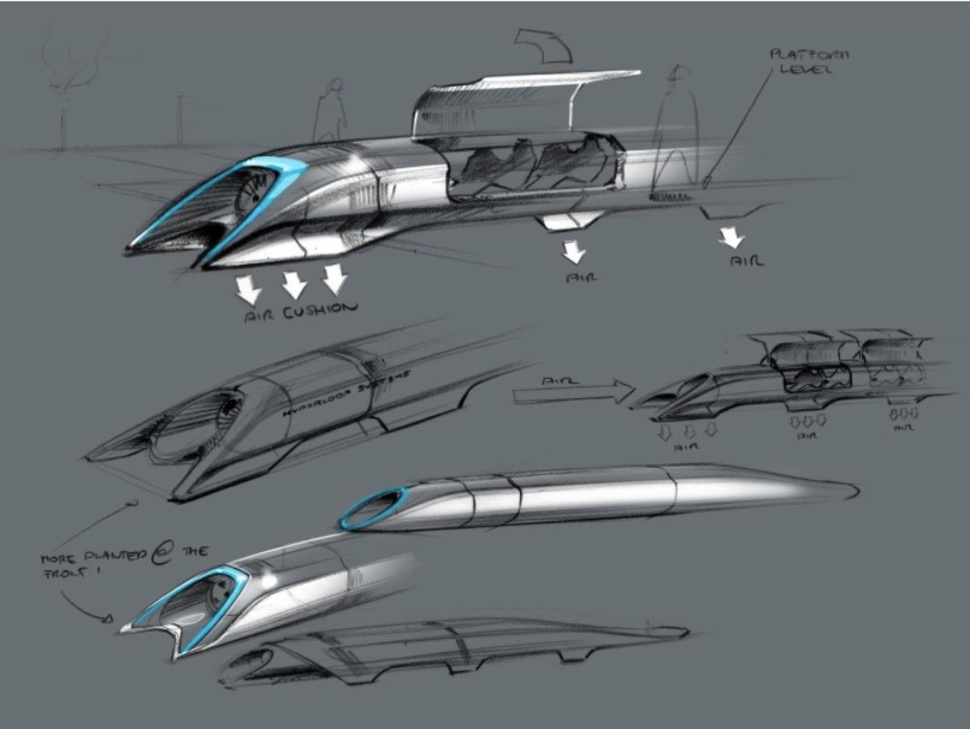
Hyperloop is essentially a train system that Musk calls "a cross between a Concorde, a railgun, and an air hockey table". It's based on the very high-speed transit (VHST) system proposed in 1972, which combines a magnetic levitation train and a low pressure transit tube. It evolves some of the original ideas of VHST, but it still uses tunnels and pods or capsules to move from place to place.


So, How fast can it go?


Hyperloop is being proposed as an alternative to short distance air travel, where the system will be much faster than existing rail networks and much cleaner that flight. Hyperloop isn't about going as fast as possible, because you'll have to deal with high G forces when it came to turns, which isn't ideal for passenger travel. Speeds of over 700mph are suggested for journeys.


But there are practical implications that have to be considered on a short stop-start journey, such as the acceleration and deceleration sensation that passengers would go through.


How does Hyperloop achieve such speeds?


Air bearings or maglev
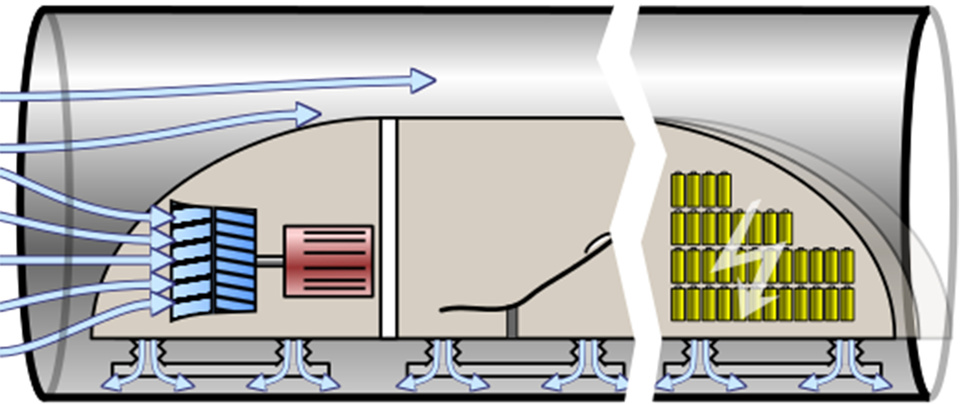
One of the biggest problems with anything moving is friction, both against surfaces and the environment the pod is moving through. Hyperloop proposes to move away from traditional wheels by using air bearings for pods instead. This will have the pod floating on air. It's similar to maglev, in which the electromagnetic levitation of the train means there is no friction like a traditional train that runs on tracks.


This is how current maglev trains can achieve super speeds, like the 500km/h maglev train in Japan. One Hyperloop proposal, from Virgin Hyperloop One, uses passive magnetic levitation, meaning the magnets are on the trains and work with aluminium track. Current active maglev needs powered tracks with copper coiling, which can be expensive.

Low pressure


Hyperloop will be built in tunnels that have had some of the air sucked out to lower the pressure. So, like high-altitude flying, there's less resistance against the pod moving through the tunnel, meaning it can be much more energy efficient, which is desirable in any transit system.

The original VHST proposed using a vacuum, but there's an inherent difficulty in creating and maintaining a vacuum in a tunnel that will have things like stations, and any break in the vacuum could potentially render the entire system useless. For Hyperloop, the idea is to lower the air pressure, a job that could be done by regularly placed air pumps.
Low pressure, however, means you still have some air in the tunnels.


The air bearing and passive maglev ideas are designed not only to levitate the pod, but also see the pod moving through the air, rather than pushing the air infront of it and dragging it along behind. The air cushion will see the air pumped from the front of the pod to the rear via these suspension cushions. The tunnels envisioned are metal tubes, elevated as an overground system.

What will it feel and sound like?


Virgin Hyperloop One said it will feel like you're riding in an elevator or a passenger plane. There will be tolerable G forces, as you will be accelerating and decelerating gradually, but there will be no turbulence. In terms of sound, people on the outside will only hear a "big whoosh". The tubes are constructed out of thick, strong steel and can handle 100 Pa of pressure or more.


Although there isn't the exact date of when this technology will be available to masses, but several tests have already been successfully conducted and we might be travelling inside these high speed vacuum pods in coming years.


Autonomous Vehicles: Future Of Personal Transportation

What’s the future of personal transportation? Well, you’ll likely be spending a lot less time behind the wheel, for one. The rise of self-driving cars means that some scenes out of science-fiction flicks (think Total Recall or I, Robot) are now reality—and even more will be available soon


So what exactly are these autonomous vehicles?


An autonomous car (also known as a driver-less car, self-driving car, robotic car) and unmanned ground vehicle is a vehicle that is capable of sensing its environment and navigating without human input.


Cars today already include many semi-autonomous features, like assisted parking and self-braking systems. And completely autonomous vehicles—able to operate without human control—are rapidly becoming more of a reality. You’re probably familiar with Google’s version, which has made headlines with its Google Chauffeur software, which the company hopes to bring to market by 2020.

Why do we need them?


The pros of autonomous cars are many. “The sensors in a self-driving car are always observing, are not affected by the state of the driver (sleepy, angry, etc.), and can scan in multiple directions simultaneously,” says Dr. Dominique Freckmann, an automotive engineering manager at TE Connectivity, a global technology leader providing connectivity and sensor solutions that are essential in today’s increasingly connected world. “Autonomous driving is a key aspect of the industry’s drive toward safer roadways.”


“Recent NHTSA research shows that approximately 94 percent of accidents are caused by human error,” adds Alan Amici, a vice president of automotive engineering at TE. “Cars with advance safety features and eventually, self-driving cars, can significantly reduce the number of collisions. The impact of this innovation can be far-reaching, including reduced demand on emergency response systems and reduced auto insurance and health care costs.”


What technology makes self-driving cars possible? 

It’s really three technologies: sensors, connectivity, and software/control algorithms.


“Most of the sensors required for autonomous driving are available today and are used in advanced safety features such as blind-spot monitoring, lane-keep assistance, and forward collision warning,” he says. “Sensors for other features such as radar, ultrasonics, and cameras provide the input necessary to navigate the car safely.”


Connectivity means cars have access to the latest traffic, weather, surface conditions, construction, maps, adjacent cars, and road infrastructure, he says. This data is used to monitor a car’s surrounding operating environment to anticipate braking or avoid hazardous conditions.


Finally, software/control algorithms are needed to reliably capture the data from sensors and connectivity and make decisions on steering, braking, speed, and route guidance.  “By far the most complex part of self-driving cars, the decision-making of the algorithms, must be able to handle a multitude of simple and complex driving situations flawlessly,” Amici says. “The software used to implement these algorithms must be robust and fault-tolerant.”


With so many advantages, why don't we see these cars more often on streets?


While technologies and capabilities continue to evolve toward making autonomous vehicles a reality, there are some hurdles. Right now, autonomous cars are legal only in a few U.S. states, as regulators weigh how to best ensure their safe interaction with standard human-driven vehicles.


“Self-driving capability will add benefits to our whole society, such as providing transportation for people who are otherwise not able to drive because of age or physical impairment,” Freckmann says. “That is both exciting and meaningful.”


Soon, your car will be able to drive itself faster and safer, while you relax in the seat.


Virtual Teams: New Way To Work

Virtual Teams is a relatively new concept of replacing the conventional and boring idea of "working in confined cubicles" with "working from the comfort of your home". This being more convenient still manages to ooze out more performance out of the employees by being more efficient. So let's know a bit more about this new way of working.

First of all, what is a Virtual Team?


Virtual team can be defined as a team of people which can be working in same office or spread across various locations- which can be different cities, countries and hence different time zones too. People of varied cultures, backgrounds and expertise come together to work on a common goal. Generally virtual teams are formed for either finding solution to critical problems, development of a new product/service and the problems of similar difficulty level.

With the advent of decentralization and globalization, organizations felt the need to adapt to something which is quick and agile in solving the problems, Virtual team offers flexibility as well as fast delivery of results. Hence it has become widely popular and used extensively by organizations all over the world. Not only IT industry, but industries like construction, manufacturing, engineering, finance and the like has been seen following the trend of virtual teams.

So now that we know what a Virtual Team is, How about we get to know what advantages it has over conventional work environment.


Saves Resources

When team is working virtually from the comfort of home, one saves cost of electricity, computer, internet and other admin services and facilities.One may think how much one save can by this. But if you think about it, furniture, computer, electricity, internet expense, a good place for people to sit comfortably, then admin charges like I-cards, canteen, lunch room will add up to considerably large amount

Wide Availability of talent


 If you are not bound by one geography to look for talent then too many avenues open up and one can get excellent talent from around the world. One can look for the most cost effective resources and earn lots of profit too.

Low attrition rate

Employees enjoy working from home as they get freedom; they have a good work life balance and at the same time a satisfaction towards their work. A higher level of satisfaction makes employees to stay in company for a very long time and hence benefitting the company. Company saves a lot on recruiting and training costs and has a skillful resource working for them.

Avoids wastage of time 

Very often companies or rather teams have too many unnecessary meetings which wastes the precious resources and time. The communication and coordination between the team and having pleasantries and discussion of agenda etc eats away lots of time. Virtual teams discuss precisely and work very fast.

Reduces cost of travelling

Everyone is tired of traffic, pollution and bad weather conditions. Travelling in train or bus in summers and in heavy traffic drains half of the energy. It takes lots of time to be able to work efficiently post one reaches the office. In virtual team the time, efforts and money of commuting to workplace is saved.


Increased productivity


Employees often face distractions from gossip, unnecessary comments, office politics and the like. These distractions are ruled out in virtual team and hence help to have higher productivity.

24*7 work possible 

If company hires virtual teams from different time zones then they can work 24*7 and thereby giving a huge boost to the company revenue.

So the conclusion?


According to the social psychologists, human relationships draw their strength from the physical proximity of the individuals. Due to the fact that virtual team members have limited or, no face-to-face interactions, it throws a myriad of challenges. For the success of virtual teams, it is important to overcome the cultural differences, communication barriers, power struggles and conflict to build trust, collaboration and commitment among the individuals. Though it sounds difficult but can certainly be achieved through effective leadership. With the right strategies, processes and tools in place, organizations can benefit greatly from this new-age trend of virtual teams.

Intuition and Business

Everyone makes many mistakes in business. But one does not have to beat himself up about them, in fact he has to be greatful to have made th...