Showing posts with label high speed. Show all posts

LiFi: The Future Of Internet


Li-Fi technology is a ground-breaking light-based communication technology, which makes use of light waves instead of radio technology to deliver data achieving speeds of 224 gigabits per second in the labs. This technology has potential to change everything about the way we use the Internet.

So let's get to know more about this seemingly impossible technological marvel.


First of all, What is this LiFi?


Light Fidelity or Li-Fi is a Visible Light Communications (VLC) system running wireless communications travelling at very high speeds.Li-Fi uses common household LED (light emitting diodes) light bulbs to enable data transfer, boasting speeds of up to 224 gigabits per second.

The term Li-Fi was coined by University of Edinburgh Professor Harald Haas during a TED Talk in 2011. Haas envisioned light bulbs that could act as wireless routers.Subsequently, in 2012 after four years of research, Haas set up company pureLiFi with the aim 'to be the world leader in Visible Light Communications technology'.

So, How does it works?


Li-Fi and Wi-Fi are quite similar as both transmit data electromagnetically. However, Wi-Fi uses radio waves while Li-Fi runs on visible light.As we now know, Li-Fi is a Visible Light Communications (VLC) system. This means that it accommodates a photo-detector to receive light signals and a signal processing element to convert the data into 'stream-able' content.


An LED light bulb is a semi-conductor light source meaning that the constant current of electricity supplied to an LED light bulb can be dipped and dimmed, up and down at extremely high speeds, without being visible to the human eye.For example, data is fed into an LED light bulb (with signal processing technology), it then sends data (embedded in its beam) at rapid speeds to the photo-detector (photodiode).

The tiny changes in the rapid dimming of LED bulbs is then converted by the 'receiver' into electrical signal.The signal is then converted back into a binary data stream that we would recognise as web, video and audio applications that run on internet enables devices.

Will it make WiFi obsolete?


While some may think that Li-Fi with its 224 gigabits per second leaves Wi-Fi in the dust, Li-Fi's exclusive use of visible light could halt a mass uptake. Li-Fi signals cannot pass through walls, so in order to enjoy full connectivity, capable LED bulbs will need to be placed throughout the home.
 Not to mention, Li-Fi requires the light bulb is on at all times to provide connectivity, meaning that the lights will need to be on during the day.Additionally, where there is a lack of light bulbs, there is a lack of Li-Fi internet so Li-Fi does take a hit when it comes to public Wi-Fi networks.

In an announcement yesterday, an extension of standard Wi-Fi is coming and it's called Wi-Fi HaLow.This new project claims to double the range of connectivity while using less power. Due to this, Wi-Fi HaLow is reportedly perfect for battery powered devices such as smartwatches, smartphones and lends itself to Internet of Things devices such as sensors and smart applications. 

But it's not all doom and gloom! Due to its impressive speeds, Li-Fi could make a huge impact on the internet of things too, with data transferred at much higher levels with even more devices able to connect to one another.

Expect to hear a lot more about this revolutionary technology in coming months. There's hardly any time left before this technology becomes mainstream and can be seen everywhere.

Hyperloop: The High Speed Transport System

Elon Musk has started building a revolutionary new transport system dubbed Hyperloop. It will allow you to travel from Bangalore to Chennai in mere 30 minutes. Musk has likened it to a vaccum tube system in hospitals used to move medications from place to place.

Confused? No worries. Here's everything you need to know about the futuristic train coming straight out of a science fiction.


First of all, What exactly is a Hyperloop?


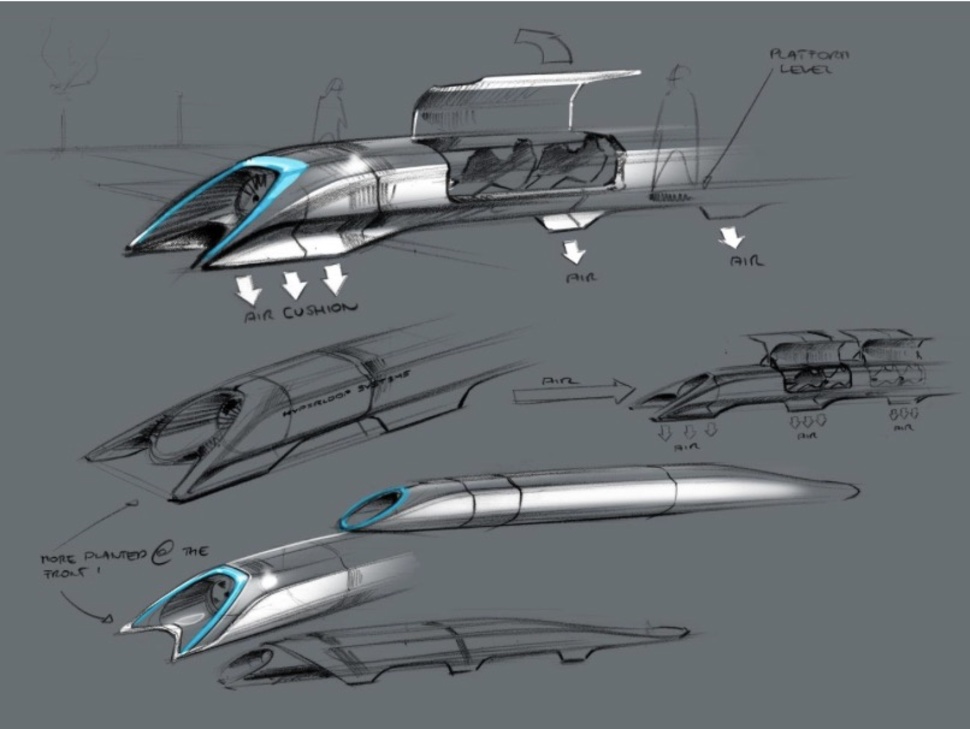
Hyperloop is essentially a train system that Musk calls "a cross between a Concorde, a railgun, and an air hockey table". It's based on the very high-speed transit (VHST) system proposed in 1972, which combines a magnetic levitation train and a low pressure transit tube. It evolves some of the original ideas of VHST, but it still uses tunnels and pods or capsules to move from place to place.


So, How fast can it go?


Hyperloop is being proposed as an alternative to short distance air travel, where the system will be much faster than existing rail networks and much cleaner that flight. Hyperloop isn't about going as fast as possible, because you'll have to deal with high G forces when it came to turns, which isn't ideal for passenger travel. Speeds of over 700mph are suggested for journeys.


But there are practical implications that have to be considered on a short stop-start journey, such as the acceleration and deceleration sensation that passengers would go through.


How does Hyperloop achieve such speeds?


Air bearings or maglev
One of the biggest problems with anything moving is friction, both against surfaces and the environment the pod is moving through. Hyperloop proposes to move away from traditional wheels by using air bearings for pods instead. This will have the pod floating on air. It's similar to maglev, in which the electromagnetic levitation of the train means there is no friction like a traditional train that runs on tracks.


This is how current maglev trains can achieve super speeds, like the 500km/h maglev train in Japan. One Hyperloop proposal, from Virgin Hyperloop One, uses passive magnetic levitation, meaning the magnets are on the trains and work with aluminium track. Current active maglev needs powered tracks with copper coiling, which can be expensive.

Low pressure


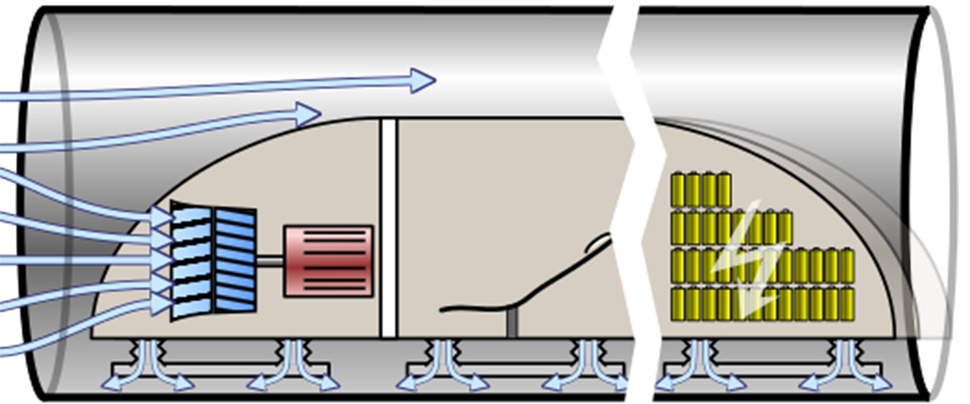
Hyperloop will be built in tunnels that have had some of the air sucked out to lower the pressure. So, like high-altitude flying, there's less resistance against the pod moving through the tunnel, meaning it can be much more energy efficient, which is desirable in any transit system.

The original VHST proposed using a vacuum, but there's an inherent difficulty in creating and maintaining a vacuum in a tunnel that will have things like stations, and any break in the vacuum could potentially render the entire system useless. For Hyperloop, the idea is to lower the air pressure, a job that could be done by regularly placed air pumps.
Low pressure, however, means you still have some air in the tunnels.


The air bearing and passive maglev ideas are designed not only to levitate the pod, but also see the pod moving through the air, rather than pushing the air infront of it and dragging it along behind. The air cushion will see the air pumped from the front of the pod to the rear via these suspension cushions. The tunnels envisioned are metal tubes, elevated as an overground system.

What will it feel and sound like?


Virgin Hyperloop One said it will feel like you're riding in an elevator or a passenger plane. There will be tolerable G forces, as you will be accelerating and decelerating gradually, but there will be no turbulence. In terms of sound, people on the outside will only hear a "big whoosh". The tubes are constructed out of thick, strong steel and can handle 100 Pa of pressure or more.


Although there isn't the exact date of when this technology will be available to masses, but several tests have already been successfully conducted and we might be travelling inside these high speed vacuum pods in coming years.


Intuition and Business

Everyone makes many mistakes in business. But one does not have to beat himself up about them, in fact he has to be greatful to have made th...